

Il suono di una transizione di fase en
From "Physics, Waves, Music": a website about the physics of waves and sound, acoustics of musical instruments, musical scales, harmony and music.
Drop a small metal bar on the floor and it rings with a clear note. Drop the same bar after it has cooled by a few tens of degrees and you hear only a dull "thud", like a piece of wood or plastic. This does not happen with ordinary metals, but it happens with bars of nitinol, a nickel–titanium alloy, and the reason is a phase transition: just above room temperature the arrangement of the atoms in the metal changes, and with it the elasticity of the material and the way the bar vibrates. Nothing changes that you can see, but you can hear it.
This page summarises an experiment, published in the American Journal of Physics[1], that follows the transition with nothing more than a microphone, a thermometer and a computer.
|
Nitinol_drop_sounds.mp3 A nitinol bar dropped on the floor, first above the transition (austenite) and then below it (martensite) |
Nitinol and its phase transition

Water freezes and boils: these are the phase transitions everyone knows, from liquid to solid and from liquid to gas. There are also transitions in which a solid stays solid but its atoms rearrange into a different crystal structure. Nitinol and similar alloys are the classic example. They are called shape memory alloys: a bent nitinol wire goes back to its original shape when heated, a property with many technological applications.
The experiment uses an alloy of nickel, titanium and copper, Ni40Ti50Cu10, which has two phases:
- at high temperature, austenite: the atoms form a cubic lattice, highly symmetric;
- at low temperature, martensite: the lattice is less symmetric (monoclinic) and is split into small regions, called twinned domains, with different orientations.
The atoms move only by a small fraction of their distance, but the macroscopic properties of the material change a lot. Unlike the melting of ice, the transformation does not happen at a single temperature. On cooling, the austenite starts to turn into martensite at a temperature MS (martensite start) and the transformation is complete at a lower temperature MF (martensite finish). In between, the two phases coexist. On heating, the reverse transformation happens at higher temperatures, between AS and AF: the state of the material depends not only on its temperature but also on whether it is being heated or cooled. This delay, called hysteresis, is the signature of a first-order phase transition. For the bar used in the experiment, on cooling, MS = 43 °C and MF = 32 °C.
Why temperature does not usually change the note of a bar
A bar that is struck vibrates mainly in its fundamental normal mode, with two nodes at 0.224 times the length from each end. Its frequency is (see natural frequencies of the bar)
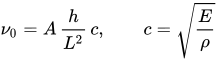
where L is the length of the bar, h its thickness in the direction in which it vibrates, A a number that depends only on the shape of the cross-section (1.028 for a rectangle, 0.890 for a circle, with h equal to the diameter) and c the speed of the elastic waves in the material, which depends on its density ρ and its Young's modulus E, a measure of its stiffness.
When an ordinary metal is heated, it expands a little (about 10−5 of its length per degree) and becomes slightly less stiff (E decreases by about 10−4 per degree). Both effects are tiny: an iron bar 20 cm long rings at 876 Hz (an A5), and between 65 °C and 20 °C its frequency changes by only 5 Hz. This is well below the change of about 1% that the ear can notice between two notes played one after the other (see perception of pitch).
The experiment

- The nitinol bar is 20 cm long, with a rectangular cross-section of about 0.7 cm × 0.6 cm, and weighs 51 g. At room temperature it is in the martensite phase. As a comparison, an iron bar of the same length is used.
- The bar hangs from two cotton threads tied at the nodes of the fundamental mode: there the bar does not move, so the threads hardly damp the vibration, and the bar behaves almost like a free bar.
- The bar is dipped in water at 70 °C, then lifted out and left to cool in air.
- While it cools, it is struck again and again in the middle with a small rubber hammer, while a thermocouple fixed near a node gives its temperature.
- The sound is recorded with a USB microphone and analysed with the free program Audacity, which shows the spectrum of each strike and the frequency of the fundamental.
|
Iron_bar_cooling_sounds.mp3 The iron bar struck while it cools from 50 °C to 30 °C |
|
Nitinol_bar_cooling_sounds.mp3 The nitinol bar struck while it cools from 50 °C to 30 °C |
The bar goes out of tune


While the iron bar keeps ringing on the same note, the note of the nitinol bar drops. Above about 45 °C the bar plays a slightly sharp C5 (538 Hz); as it cools through the transition the note slides down through more than a fifth, to a sharp E4 (about 330 Hz) at 30 °C: almost 40% lower in frequency. Below and above the transition the frequency hardly changes.
Between MS and MF the frequency falls by about 23 Hz for every degree, more than 200 times faster than for iron, and in the opposite direction: the nitinol bar plays lower as it gets colder.
Where does such a large change come from? The length and thickness of the bar change very little, and the density of the two phases differs by less than 5%. What changes is the stiffness of the material. The wavelength of the fundamental mode is fixed by the length of the bar, so if the waves travel more slowly in the material the frequency must decrease (see speed of mechanical waves). Using the formula above, the frequencies give the Young's modulus: about 69 GPa for austenite and 26 GPa for martensite, in agreement with the values found in the literature for nitinol. Austenite is almost three times as stiff as martensite.

The reason lies in the atoms. In the cubic lattice of austenite, deforming the material means stretching the bonds between the atoms, which resist equally in all directions. In martensite, the twinned domains can reorient themselves under stress with little effort, and so they absorb part of the deformation: the material is softer. Between MS and MF the two phases coexist, and the stiffness of the bar passes gradually from one value to the other.
From a "ring" to a "thud"

The note does not only become lower: it becomes less and less defined, until below MF the bar no longer seems to play a note at all. Yet the recorded waveform still shows regular oscillations, and the spectrum still has a peak at the fundamental. What changes is how long the sound lasts.
The sound of the struck bar fades away exponentially, but very differently in the two phases: in this case, the sound of austenite takes about 150 ms to decay by a factor e (about 9 dB), that of martensite only about 10 ms. To perceive a definite pitch the ear needs a sound that lasts long enough (see the envelope of a sound and perception of pitch): the long sound of austenite is heard as a note, the very short one of martensite as a "thud". In the spectrum, a short sound gives a wider peak, that is, a less defined frequency.
The energy of the vibration is lost by internal friction in the metal: at every oscillation the material is compressed and stretched, and part of the elastic energy turns into heat. In the ordered lattice of austenite this loss is small. In martensite the boundaries between the twinned domains move back and forth with every oscillation, and dissipate energy: martensite is an excellent damping material. The losses can be measured by the quality factor Q of the fundamental mode: across the transition, the losses (1/Q) of the nitinol bar increase by about ten times, while for the iron bar they stay the same.
So with a single experiment one can hear, and measure, two different effects of the same change in the arrangement of the atoms: the frequency tells how stiff the material is, the duration of the sound how much energy it dissipates.
Trying it yourself
The article gives some practical advice for repeating the experiment, for example in a school laboratory:
- nitinol bars like the one used are commercially available for a few tens of dollars; the transition temperatures depend somewhat on the sample;
- a bar with a rectangular cross-section is better than a square one: the two directions of bending then have different frequencies, and no beats appear while the sound decays;
- mark the nodes (at 0.224 times the length from each end) and the middle of the bar in a bright colour. Instead of hanging the bar, you can hold it at a node with a gloved hand and strike it with the knuckles of the other hand: the measurement of the decay time is less precise, but you can keep the bar close to your ear;
- a thin bar radiates sound poorly: its sound is clearly audible only within about one metre, so place the microphone close to it;
- let each strike die out completely before the next one, and note the temperature each time (for example by reading it aloud, so that it is recorded together with the sound);
- in Audacity, the waveform can be shown on a decibel scale: the exponential decay then becomes a straight line, whose slope gives the decay time and Q.
References
- ↑ 1,0 1,1 1,2 1,3 1,4 1,5 1,6 C. A. Rozzi, A. Lisotti, G. Goldoni and V. De Renzi, "Listen! it's a phase transition. The sound of a shape memory alloy", Am. J. Phys. 93, 789–796 (2025), doi:10.1119/5.0217522 (open access). The figures and recordings on this page are taken from the article, under the CC BY 4.0 licence.
