

Domande suono en
From "Physics, Waves, Music": a website about the physics of waves and sound, acoustics of musical instruments, musical scales, harmony and music.
| AI-translated from Italian. Original page: Domande_suono |
Does an environment with absolutely no sound exist?
- The propagation of sound requires a material medium. Sound is a mechanical elastic wave, which can exist only if there are oscillating elements to transmit it. If we pump the air out of a container, the sound produced by an object inside the container is attenuated until it disappears completely. This happens even if the vacuum is not very high (a few Torr, corresponding to a few hundred Pa, can be obtained with a school laboratory pump). All the more so, sound cannot propagate in interplanetary space, where the vacuum is incredibly higher than can be obtained in any laboratory on Earth (from 10-6 to <3×10-17 Torr, corresponding to 100 µPa ÷ 3×10-15 Pa).
- Consequently, all the films in which spaceships cross space with roaring engines are spectacular but inaccurate. In the same way it is not possible to hear an explosion, nor even to be hit by a shock wave (which is also an elastic wave), but only, possibly, by the stream of debris produced by the explosion itself.
- In a normal atmosphere a special anechoic chamber can be built. It is a room entirely lined with sound-absorbing material and isolated from outside noise. Sound can propagate freely in the chamber, but it is not reflected in any way by the walls of the chamber, nor can it reach it from outside. The anechoic chamber makes it possible to measure and record a sound source without any effect due to the surroundings. Many recordings of vocal performances are made in this environment, with reverberation effects added later by manipulating the sound electronically. Staying in an anechoic chamber is, however, particularly unpleasant, and makes us appreciate the importance of the sound environment in which we are immersed every day, perhaps without noticing it.
- Electromagnetic waves, on the other hand, propagate in vacuum because the electromagnetic field does not need a medium to support it. However, it is also possible to build an anechoic chamber for certain types of electromagnetic waves (typical ones are those for studying radio-frequency equipment).
- For related topics see the pages architectural acoustics and reflection of sound
What is the loudest possible sound that can be produced?
Sound is the product of a succession of compressions and expansions in an elastic medium. Air is a mixture of gases and, at sea level, has an equilibrium pressure of 1 atmosphere (corresponding, in the International System of units, to about 101 kPa). It is therefore clear that the largest expansion theoretically obtainable is one that brings the medium to a pressure of 0 Pa (high vacuum). The corresponding sound wave must therefore cause a pressure variation of ± 101 kPa, corresponding to a sound pressure level of 194 dB (see sound pressure levels). Such a sound, even if it could physically be generated, could not be perceived, because it exceeds the human threshold of pain (which corresponds to a sound of about 120 dB(SPL), see perception of loudness). It is of course possible to produce compressions greater than 1 atmosphere in air, but the corresponding disturbance no longer behaves like a sound wave, but like a shock wave.
Just to give an idea, writing dB(SPL) for the decibels of the sound pressure level (Sound Pressure Level):
|
|
- A shock wave at 163 dB(SPL) can break ordinary window glass (see also the relevant question and answer)
- A human being does not survive a shock wave of 200 dB(SPL);
- At lift-off the Space Shuttle produces a gas flow with a speed of about 5 km/s, corresponding to a sound pressure level of 215 dB(SPL) at a distance of 1 m. Fortunately, shock waves decay with distance faster than sound waves, so the safe distance for watching the launch is about 5 km.
- The atomic bomb dropped on Hiroshima on 6 August 1945, with a yield of about 15 kilotons, is estimated to have produced a shock wave of 248 dB
- The 1883 eruption of the Krakatoa volcano, in Indonesia between the islands of Java and Sumatra, was heard on the coasts of Australia (3000 km away) and on Rodrigues Island (5000 km away in the Indian Ocean). It produced a 30 m tsunami 300 km away, and the change in atmospheric pressure made barometers oscillate hundreds of km away, also causing fog to appear and disappear instantly. At a distance of 160 km, barometers recorded a pressure increase of about 8.5 kPa (about 172 dB SPL), and the pressure wave travelled around the world several times: barometers all over the planet recorded it for five days (seven passages).
Remember that dB are a logarithmic scale, and that the corresponding pressure doubles every 6 dB.
What is the relationship between the frequency and the pitch of a sound?
Do not settle for the simplistic answer that the frequency of the sound wave determines the pitch of the sound.
This answer is reasonably satisfactory only if we are talking about a single pure sound (that is, a harmonic wave) that is long enough and lies within a precise range of amplitude and frequency, in ideal conditions.
A more complete answer is also much more complex and fascinating, because many factors contribute to determining the perceived pitch of a sound. The determination of pitch by the brain is a phenomenon that, starting from a sound signal, goes through the complicated human auditory system, which means that the original signal is manipulated and transformed several times before reaching the brain in the form of packets of electrical impulses.
It follows that the determination of pitch, like that of the other perceptual quantities of a sound signal, is a property not only of the sound, but also of the physiological characteristics of the auditory system and, finally, of the massive selection and transformation carried out by the brain on all the signals it processes.
- For a discussion of these topics see the pages perception of sound, perception of pitch, physiology of the auditory system, and the pages linked to them.
If a sound is composed of many harmonic sounds of different frequencies, which harmonic determines the sound pitch that is perceived?
Again, do not settle for the simplistic answer that the fundamental (that is, the harmonic component with the lowest frequency) determines the perceived pitch.
There is no single simple answer to this question, because the perceived pitch actually depends on many concurrent factors. It can easily be shown that, in some cases, removing the fundamental (and sometimes several other low harmonics) does not substantially change the perceived pitch, while in other conditions, leaving the fundamental unchanged and changing the frequencies or amplitudes of the higher harmonics, the perceived pitch seems to change considerably.
- For some curious examples of these effects see the page on acoustic effects and illusions.
- See also the previous question, the pages perception of sound, perception of pitch, physiology of the auditory system, and the pages linked to them.
Is it true that sound intensity is proportional to the square of pressure? Why?
To answer, let us start with a dimensional argument, to find a useful expression for the unit of sound intensity.
As you can see on the page perception of loudness, sound intensity I is measured in W/m2. Let L and T be the dimensions of length and time. Intensity therefore has the dimensions of a power W over an area (L2). The power W has the dimensions of an energy E over a time T, and the energy E those of a force F times a length L. In summary:
,
![{\displaystyle [I]={\frac {W}{L^{2}}}={\frac {E}{L^{2}T}}={\frac {FL}{L^{2}T}}={\frac {F}{L^{2}}}{\frac {L}{T}}}](./math/055b19ae3957f059fb50817c2da56d1ce8bc34fa.svg)
where the square brackets mean "dimensions of".
But F/L2 is a force over an area, that is, a pressure P, while L/T, length over time, is a velocity U. So we have a general relation between intensity, pressure and velocity:

Now, if we define the impedance Z as on the page on impedance, that is, as the ratio
- ,

and substitute it into the expression for I, we trivially obtain
- .
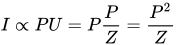
From a purely mathematical point of view, all this is simple. What is less obvious is what kind of quantity Z is. In fact it is not a simple constant, because pressure and velocity can be out of phase with each other, and moreover Z generally depends on the frequency of the wave.
For somewhat more advanced examples see also the page acoustic impedance.
