

Impedenza acustica en
From "Physics, Waves, Music": a website about the physics of waves and sound, acoustics of musical instruments, musical scales, harmony and music.
| AI-translated from Italian. Original page: Impedenza_acustica |
Definition and units
Acoustic impedance is the quantity that describes how a fluid opposes the passage of sound waves. These waves, produced by a succession of compressions and rarefactions, are locally associated with the oscillatory motion of the molecules of the fluid. The details of the relation linking, at every instant, the pressure of the fluid with the velocity of the fluid depend on the nature and state of the fluid, but they can often be represented by a linear response function, that is, to a first approximation the velocity is directly proportional to the pressure.
Several types of impedance are used in acoustics.
- The acoustic impedance proper is the ratio between the sound pressure p and the flow of the fluid U (or volume flow rate) at a point

where the flow is equal to the velocity of the fluid u multiplied by the area A it passes through (U=uA). The unit of acoustic impedance in the international system is Pa · s/m3. In the cgs system the unit is the acoustic ohm. A medium has an impedance of 1 acoustic ohm when a pressure of 1 dyne/cm2 produces a flow of the fluid equal to 1 cm3/s.
- The specific acoustic impedance is the ratio between the sound pressure p and the velocity of the fluid at a point.
- .

This quantity is used, instead of the simple impedance, when one wants to refer to the local or specific properties of a medium without reference to the particular area affected by the motion. In the mks system it is measured in rayl (1 rayl = 1 Pa s/m = 1 kg/(m2s))
- Since acoustic pressure varies over a wide range of orders of magnitude, the impedance (like the sound pressure level) is typically expressed on a logarithmic scale (see sound pressure levels).
Acoustic impedance is normally calculated or measured in the oscillatory regime, and is therefore a frequency-dependent quantity with an amplitude and a phase. The amplitude gives the ratio between the modulus of the oscillating pressure and the modulus of the oscillating flow, while the phase indicates how much the flow of the fluid lags or leads the pressure. See also the discussion of the effects of impedance. In this connection one also defines
- Characteristic impedance: it is like the specific acoustic impedance, but is measured with respect to a particular input signal: a progressive plane wave. It is always equal to the product
(1)

where is the density of the medium, and c the speed of sound in the medium. Like the specific acoustic impedance, in the mks system it is measured in rayl.

Elementary components for "acoustic circuits"
As happens for electrical circuits, if the wavelength of the waves passing through a physical system is much greater than the size of its components, it is often possible to represent the physical quantities of the system as if each were "concentrated" in a specific component (for the approximations this involves see the discussion in analogies in physics). It is therefore possible to study a vibrating acoustic system by analysing its equivalent acoustic circuit. Likewise, it is often much simpler to study an equivalent electrical circuit experimentally than to build a scale mechanical model.
The following sections define the elementary acoustic elements, which can be used in the analysis of musical instruments and other sound systems.
Acoustic resistance
As for electrical resistance, this type of acoustic resistance is a term that dissipates energy. In the specific acoustic case, the resistance sums up all the energy losses due to friction of the viscous type, that is, to forces that oppose the sliding of the fluid molecules in direct proportion to the flow velocity. Calling the acoustic resistance, the equation of state of this element is therefore of the type

. (2)

where we see that the flow of the fluid in the resistive element is directly proportional to the pressure difference across the element (see analogies in physics).
Obviously fluids can show other forms of friction and turbulent motion, and these phenomena are of great importance in acoustics, but, being nonlinear, they cannot be represented by a linear element like the one illustrated here.
Acoustic compliance
Compliance is the property of a portion of fluid of storing elastic potential energy when the fluid is subjected to a compression or a rarefaction. Compressible fluids such as air, in fact, when enclosed in a rigid container, behave like a spring when subjected to small compressions or rarefactions. That is, they exert a force opposing the compression (or rarefaction) that is directly proportional to the size of the compression (or rarefaction) itself, and also depends on the particular thermodynamic regime in which the transformation takes place (see the section "How does a compressed gas behave?"). The prototype of the compliance element is a cavity with rigid walls containing a certain mass of fluid. Calling the acoustic compliance and dV the change in volume, its equation of motion is

(3)

and it says that the change in volume is directly proportional to the pressure difference that produces it. Note that the acoustic compliance corresponds to the inverse of the equivalent elastic constant of the fluid. Since, calling c the speed of sound in a fluid of density ρ, the relation between pressure and change in volume is in general
- ,
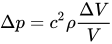
we obtain the compliance of an acoustic element of volume V:
. (4)

Compliance is the acoustic equivalent of the inverse of the elastic constant for a mechanical system. The two quantities are identical, apart from the factor A2, which accounts for the different dimensions. The elastic constant of a cavity containing air is therefore
- .

Inertance
When a portion of fluid is free to flow, as happens for example along an open duct, the pressure applied to the fluid does not result in a change in its volume, but in motion. This means that the work done by external forces on the fluid is not stored in the fluid as elastic potential energy, but as kinetic energy. The linearised equation of motion in this case is analogous to that of a point mass, the only difference being that the cross-section of the tube must also be taken into account. Indeed
, (5)

where, calling m the mass of the moving fluid and u its velocity, we have defined
- ,

and
- .

We thus see that acoustic inertance is the quantity equivalent to mass in mechanical systems (apart from the factor A2, which corrects the dimensions). For example, in an open cylindrical tube of length l and radius R, filled with a fluid of density ρ free to flow, the inertance is
. (6)

Applications
- Acoustic impedance is a physical quantity particularly suited to describing the response of a musical instrument at the various frequencies. It is, in fact, a characteristic of the instrument, independent of the player who plays it. One should not think, however, that the quality of an instrument can be uniquely determined by measuring its frequency response. Quality, in fact, is not an objective parameter and must be assessed case by case by human listeners (see the discussion of the individual musical instruments). The response, on the other hand, is an objective property of the physical system. One can of course discuss how quality and response are correlated.
- As regards the resistive component, we can say that if an acoustic system has a "large" specific impedance, a large acoustic pressure is needed to obtain a high fluid velocity. Conversely, if the impedance is small, even a small acoustic pressure can produce a flow of fluid with considerable velocity.
- As regards the reactive components (analogous to electrical capacitance and inductance), the fluid does not dissipate energy, but transforms it from kinetic energy into elastic potential energy, or vice versa. The net effect, however, depends on frequency, exactly as in the electrical and mechanical cases, and so a "filter effect" can occur (attenuation at some frequencies but not at others). This effect is very evident in the case of resonance (see also impedance of the harmonic oscillator).
- At the resonances of an acoustic system the impedance (measured at the mouthpiece) shows very pronounced maxima or minima. Wind instruments can operate at the minima or at the maxima of their impedance, depending on the type of coupling between the source of the oscillations and the resonating body. See flute and clarinet as examples of instruments that operate at impedance minima and maxima respectively.
- Air has its own characteristic impedance, which can be obtained by substituting the values of the density and of the speed of sound directly into relation (1). This gives a temperature-dependent quantity, whose average value at room temperature and at sea level is about 410-415 Pa s/m. The value of this impedance also coincides with the specific impedance of a cylindrical pipe, which therefore does not depend on the construction details of the pipe itself.
