

Domande misura en
From "Physics, Waves, Music": a website about the physics of waves and sound, acoustics of musical instruments, musical scales, harmony and music.
| AI-translated from Italian. Original page: Domande_misura |
What unit of measurement is the decibel?
The decibel (symbol dB) is one tenth of a bel. The bel (symbol B) is a measure of the ratio between two homogeneous quantities, that is, two quantities of the same kind, such as two intensities, two powers, two pressures, etc. The ratio between two non-homogeneous quantities cannot be measured in dB. The bel is therefore a dimensionless unit. To convert a value in B into one in dB, simply multiply it by 10.
Suppose we want to measure in dB the level of a power W. First of all we must choose a reference level W0, which we will consider as our "zero level". This reference is arbitrary, and we can choose it as is most convenient for us. Then, given the power W, its value in dB with respect to the reference level is
- .
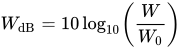
Of course, if we choose a different value for , the value of in dB will be different!


- A table with the values in decibels corresponding to various ratios is on the page useful values in dB. You can also consult a more specific page on sound pressure levels.
Why should we complicate our lives with a logarithmic scale?
The logarithmic scale is not always intuitive to use: for example, an increase of only 3 dB corresponds to doubling the measured power (or intensity), not to an increase of three units (see the question on the 3 dB level). However, it has two great advantages:
- With a logarithmic scale it is much easier to make calculations and measurements on quantities that vary over a very wide range of values. For example, in acoustics, the human ear is sensitive to sound intensities ranging from 0 to about 130 dB (the threshold of pain), that is, by a factor of 1013. A frighteningly large range. If these were lengths, we would be dealing with values ranging from the thickness of a banknote (10-4 m) to about two and a half times the distance between the Earth and the Moon (109 m).
- With a logarithmic scale some common mathematical operations are simplified. For example, to multiply two values it is enough to add their values in dB, while to divide them it is enough to subtract their values in dB.
- To see the wide range of variation of, for example, audible sound pressure, consult the table in sound pressure levels
Why are decibels more commonly used than Bels?
First let us ask: by how much does the value of a quantity X change when its level changes by one bel? Since bels are the base-10 logarithm of the ratio between X and its reference level, we must increase X tenfold to increase the level by one bel. 2 B correspond to an increase by a factor of 100, 3 B by a factor of 1000, and so on (for a summary table see the page useful values in dB).
It is immediately clear that the bel is an extremely large unit. The use of the dB, a unit ten times smaller, is therefore justified for practical reasons.
Why do scales in dB all have a factor of 10 in their definition?
dB means decibel, that is, one tenth of a bel. The measure in bels of a quantity I with respect to a reference value I0 is defined as
- .
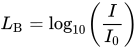
Consequently, the number of decibels for the same quantity is ten times larger, exactly as the number expressing a length in decimetres is ten times larger than the number expressing the same length in metres. See also sound pressure levels and useful values in dB.
Are there different types of decibel scales?
Yes. The decibel is not a true unit of measurement, but rather a dimensionless logarithmic scale in which a physical quantity (any quantity) is measured relative to a value chosen as "zero". Consequently we must be very careful about
- the unit of measurement of the original physical quantity
- the value chosen as the reference for "zero".
If the value of the zero level is not specified, values in dB make sense only for measuring ratios of quantities. If instead the value of the zero level is specified, then the dB becomes equivalent to an absolute measure in the unit of the zero level.
The International System therefore allows a single symbol, dB, provided that the zero level is always clearly indicated. In practice, however, abbreviated notations such as the following are used:
In acoustics at least three types of dB scale are used:
- dB(SPL): sound pressure scale relative to the threshold of hearing (20 μPa in air, 1 μPa in water)
- dB(SIL): sound intensity scale relative to the threshold of hearing (in air 10−12 W/m2)
- dB(SWL): sound power scale relative to a power of 10−12 W
Moreover, since acoustic measurements are very often converted into electrical ones (for example by microphones), power measurements on the following scale are also used
- dBm or dB(mW): power scale relative to 1 mW
and there are many others in common use.
Why does the sound pressure level (SPL) scale have a factor of 20 instead of 10 in its definition?
The sound pressure level is a special measure, because it refers to the square of the pressure rather than to the pressure itself. The reason for this choice is that the square of the acoustic pressure is proportional to the intensity of the sound field at the measurement point. So the SPL value can easily be converted into a value for the sound intensity level. For the definition of SPL and a table of the corresponding pressure values, see the page sound pressure levels. For a proof that the square of the pressure is proportional to the sound intensity, see the question Is it true that sound intensity is proportional to the square of pressure? Why?
The rest is just a little mathematics: by the properties of logarithms (see the page the logarithm function) the logarithm of the square of a quantity is twice the logarithm of that quantity, that is
- .

The factor 10, instead, comes from the definition of the dB (see the question Why do scales in dB all have a factor of 10 in their definition?).
Why are there sometimes scales with negative dB on apparatuses?
We have seen that the dB measures the level of a quantity relative to an arbitrary reference level. Now, if we choose this reference as the maximum value the quantity can take on a certain scale, the ratio of any other value to the reference is a number smaller than one. But to obtain the value in dB we must take the logarithm, and the logarithm of a number smaller than one is always negative.
So negative values, for example of the power of a hi-fi system, simply mean that the reference value (the zero level of the scale) on that apparatus is the maximum power the hi-fi can deliver.
Why is the level ± 3 dB highlighted on some apparatuses?
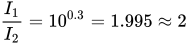
Remember that dB measure a level on a logarithmic scale. So, for example, an increase of 3 dB in the intensity of a sound corresponds approximately to doubling its intensity, and a decrease of 3 dB corresponds to an intensity that is almost halved.
Indeed, let I0 be the reference level of the intensity I. Given two levels I1 and I2 such that
- ,

this means that
- ,

that is
- ,
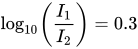
from which we obtain
- .
- A table for converting some values in dB is on the page useful values in dB.
Does a 20 dB sound have double the intensity of a 10 dB sound?
Absolutely not.
Remember that a measure in dB is a measure on a logarithmic scale. This means that increasing a level by 10 dB (equivalent to 1 B) means increasing the measured quantity by a factor of 10. To double the intensity it is enough to increase the level by about 3 dB.
For example, imagine a sound B twice as intense as a sound A, that is

If we use the logarithmic scale and the well-known properties of logarithms, calling I_0 the reference level for the intensity, we obtain


and since , we can write


that is, sound B is 3 dB more intense than sound A.
See also the question on the dB scale and the table of useful values in dB. A similar calculation also shows that a sound four times more intense than has a value 6 dB higher, one eight times more intense 9 dB, and so on.

A clarification is needed in the case of sound: the Italian term intensità is ambiguous, because it means both perceived intensity (in English loudness) and intensity in the physical sense, that is, the power radiated per unit area (in English intensity). Both quantities can be expressed on a logarithmic scale but, while the first is a subjective measure (even though standardised tables exist), or at least one that depends on the characteristics of the auditory system as well as of the sound, the second measures a physical property belonging only to the radiated sound, and therefore, given the boundary conditions, to the source and the medium. On this subject see the pages on the physiology of the auditory system and on the perception of loudness.
- A table for converting some values in dB is on the page useful values in dB, and a more specific one on sound pressure levels.
Why do we measure the angles in radians?
Since middle school we have been taught to measure angles in sexagesimal degrees and to indicate the measure with a small circle at the top right of the number (e.g. 240°). For example, the notorious right angle corresponds to 90°, the sum of the interior angles of a triangle, in the peaceful world of Euclidean geometry, is 180° (straight angle), and, last but not least, the full angle is 360°. There is, however, another way of measuring angles that is much more natural once its geometric and physical motivations are understood.
To introduce this new way of measuring angles, consider a circle of radius R and on it an arc subtending an angle of α° (of course the angle is still measured in degrees!). We now ask: how long is the arc AB? Since "equal arcs subtend equal angles at the centre", we can answer the question with a simple proportion:

(1)

where is the length of the whole circumference. From proportion (1) we then obtain

(2)

If we now define
(3)
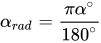
(2) becomes
(4)

From (4) we can then:
- define the radian as the angle at the centre subtended by an arc as long as the radius of the circle it belongs to;
- appreciate that measuring angles in radians makes the proportionality constant between arc length and radius of the circle much simpler;
- realise that, for circles of unit radius, the number expressing the angle at the centre in radians also expresses the length of the arc that this angle subtends.
