

Trasmissione e riflessione en
From "Physics, Waves, Music": a website about the physics of waves and sound, acoustics of musical instruments, musical scales, harmony and music.
| AI-translated from Italian. Original page: Trasmissione_e_riflessione |
Refraction of waves in a string

- Consider two sections of string of different density joined one after the other. Let us make a small effort of abstraction and imagine that both strings are ideal, and that the joint is an equally ideal weld. This effort is rewarded by the fact that all calculations are simpler under these assumptions. For example, we can say that the tension T is the same along the whole resulting composite string.
- Waves move with different speeds in the two strings taken separately; indeed (see wave equation in a string, natural frequencies of the string and speed of mechanical waves), calling ρ1 and ρ2 the respective densities, we have
;


Now consider a transverse wave travelling along the composite string from the section of type 1 towards the section of type 2. It will cross the first section with speed v1 but, when it reaches the joint, it is forced to change speed suddenly. This is a typical case of refraction. At the discontinuity the wave is partly reflected and partly transmitted. Its energy is therefore redistributed between the strings.
- We want to calculate the amplitudes of the reflected wave and of the transmitted wave, given the incident wave.
Let us first consider, for computational simplicity, harmonic waves, and place the origin of the coordinates x=0 at the joint. Calling v1, v2 the absolute values of the propagation speeds in strings 1 and 2 respectively, and ω the angular frequency of the wave, we distinguish
- incident wave: it propagates only to the right in string 1, with amplitude Ai
- transmitted wave: it propagates only to the right in string 2, with amplitude At
- reflected wave: it propagates only to the left in string 1, with amplitude Ar



- To solve the problem we now need equations relating the known quantities Ai, v1, v2 to the unknown ones At and Ar. These equations can be derived from the physics of the problem:
- the string must remain continuous at the joint during the motion, so the displacement of the right end of string 1 must be the same as that of the left end of string 2. This condition requires that the sum of the incident and reflected waves be equal to the transmitted wave at the joint x=0
- .
. (1)
- The transverse velocity of the two sections of string at the point of contact must also be the same. Unfortunately, however, this geometric condition is not mathematically independent of the previous one, since the angular frequency of all the waves on the string is the same, and so the condition was automatically satisfied the moment we used a single ω. To impose an independent condition, we can observe that the slope of the string (that is, the derivative with respect to x) must also be continuous at the joint. Differentiating with respect to x, then, and imposing equality at all times, we obtain
- ,
. (2)





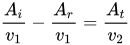
Incidentally, we note that this condition can also be imposed dynamically: since the joint is ideal, that is, it reduces to a point of zero mass, the transverse force from the side of string 1 must be equal to the force from the side of string 2. If this were not so, a finite force on a zero mass would produce an infinite acceleration. Remembering that

(see wave equation in a string), we see how the derivative with respect to x also appears from the dynamical argument.
Using equations (1) and (2) we are now able to derive the desired transmission coefficient CT and reflection coefficient CR.
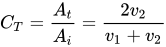
- The transmission coefficient is the ratio between the amplitude of the transmitted wave and that of the incident wave
. (3)
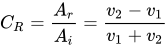
- The reflection coefficient is the ratio between the amplitude of the reflected wave and that of the incident wave
. (4)
As a useful check, note that:
- CT can only be positive: the sign of the velocity of each wave lies in the sign used inside the sine function, while v1 and v2 are the absolute values
- CR, instead, can have either sign. When it is positive it indicates that the reflected wave is in phase with the incident one, while when it is negative it means that it is in phase opposition. In particular, if v1>v2 we always have CR < 0, while if v1 < v2 we always have CR > 0.
- If it means that the joint is practically motionless, and behaves like a fixed end. The incident wave tends to be completely reflected with phase inversion (CR=-1 and CT=0).
- If it means that section 2 of the string has negligible mass, and the end behaves as if it were free. The incident wave again tends to be completely reflected, but in phase (CR=1). The value CT=2 indicates that the end, free to move, oscillates with twice the amplitude of the incident wave (sum of the incident wave and of the in-phase reflected wave).
- If v1=v2 it means that the two sections of string have the same mass, and the joint becomes just any point of the string. The incident wave is completely transmitted (CR=0 and CT=1).


The page rifrazione in una dimensione (in Italian) contains a gallery of animations illustrating these limiting cases, and other intermediate cases.
