

Onde elettromagnetiche en
From "Physics, Waves, Music": a website about the physics of waves and sound, acoustics of musical instruments, musical scales, harmony and music.
| AI-translated from Italian. Original page: Onde_elettromagnetiche |
WARNING: the field of electromagnetism and the study of electromagnetic waves are currently beyond the scope of this site. The definition of electromagnetic wave is given here only for completeness. All the wave phenomena met in the various pages also apply to electromagnetic waves, on a different scale of space and time, while some new phenomena are exclusive to them and are not analysed here.
What is an electromagnetic wave?

An electromagnetic wave is a disturbance, simultaneously electric and magnetic in nature, that propagates through space and can carry energy from one point to another. This disturbance consists of the simultaneous vibration of two immaterial entities, called the electric and magnetic fields, around their equilibrium position (which corresponds to the absence of disturbance).
Behind its apparent abstruseness, this definition hides a physical entity that is in fact extremely familiar, whose presence we experience continuously in everyday life. The following are electromagnetic waves:
- the light emitted by the sun, by a lamp or by any source able to illuminate objects. This is what we call visible light;
- the infrared radiation emitted by radiators or by our bodies simply because they are at a certain temperature. You will have heard (at least in spy films) of cameras able to "see" infrared radiation;
- the microwaves emitted by the ovens of the same name that we use to heat food quickly;
- the radio waves by means of which all modern telecommunications (radio, television, mobile phones...) are possible;
- the famous ultraviolet rays, to which we owe much of our summer tan;
- the notorious X-rays used in medicine to take radiographs of bones;
- rays (they really exist!), which, instead of being fired by improbable weapons of equally improbable aliens, are radiation emitted in nuclear disintegrations and extremely harmful to biological tissue.

The best known of all speeds
Another aspect that makes electromagnetic waves so unconsciously familiar to us is that they propagate, in vacuum, with the best known of all speeds: the speed of light. It appears in the most famous equation of physics

where the constant
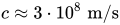
is precisely the speed of light. Since light is a transverse wave, it should be possible, with formulas similar to those derived for transverse waves in solids, to deduce this constant c from the properties of the medium.
But be careful: even if the analogy may be valid for some dielectric media, it cannot be generalized. Indeed, electromagnetic waves, unlike mechanical waves, do not need a material medium to propagate, but only the vibration of the electric and magnetic fields.
Historically, this fact was very hard to accept: until 1905 (the year in which Einstein published the paper founding the theory of special relativity) physicists tried to detect the extraordinary medium (named the luminiferous aether) that could extend the electro-mechanical analogy to vacuum as well. To account for the extraordinarily high value of the speed of light, and for other properties of electromagnetic propagation, this medium, which was supposed to permeate all of space, would have to have contradictory properties, such as
- an extraordinarily high rigidity (that is, an extremely high resistance to transverse stresses: we could say a large value of the shear modulus G);
- a very low density, both to make the value of large and to account for the fact that this medium should offer no dynamic resistance (friction) to the motion of the planets.

The electromagnetic spectrum
The set of electromagnetic waves makes up the so-called electromagnetic spectrum. Within the spectrum, electromagnetic waves are classified according to their wavelength or, equivalently, their frequency .


As for every wave, the wavelength and the frequency are related by:

where c is the propagation speed of electromagnetic waves, which in vacuum is the famous speed of light, equal to km/s. The wavelength and the frequency are therefore inversely proportional: the shorter the wavelength, the higher the frequency.

| Type of electromagnetic radiation | Frequency | Wavelength |
|---|---|---|
| Radio waves | < 3 GHz | > 10 cm |
| Microwaves | 3 GHz – 300 GHz | 1mm – 10cm |
| Infrared | 300 GHz – 428 THz | 700nm – 1 mm |
| Visible light | 428 THz – 749 THz | 400 nm – 700 nm |
| Ultraviolet | 749 THz – 30 PHz | 10 nm – 400 nm |
| X-rays | 30 PHz – 300 EHz | 1 pm – 10 nm |
| Gamma rays | > 300 EHz | < 1 pm |

- Looking at the table, it immediately catches the eye (quite literally) that what we call visible light is only a very small "optical window" of the electromagnetic spectrum. The wavelength of visible light ranges from 400 nm to 700 nm;
- in this sense the eye is not very different from the ear, which can perceive only sound waves with certain frequencies;
- the similarity with the auditory system does not end here: just as the frequencies of audible sound waves largely determine what is called the pitch of a sound, the variation in the wavelength of visible light determines the colour of the light itself (from violet to red for increasing wavelengths, or decreasing frequencies). This is why the optical window of the electromagnetic spectrum is often represented so as to show also the information about colour.
- In musical language itself, the term "chromaticism" is used to indicate the variation in frequency of a sound.
- In acoustics one speaks of coloured noise to indicate sound waves in which certain spectral components prevail over others. The analogy goes further: noise is "coloured" using the "palette" of the electromagnetic spectrum. Violet noise, for example, is rich in high-frequency sound waves, as opposed to red noise, in which lower-frequency sound waves prevail.
- You may have heard of the "red shift" of the light coming from galaxies moving away from the Earth. The phenomenon is due to the decrease in the perceived frequency of an electromagnetic wave emitted by a source moving away from the receiver (Doppler effect). Thanks to the electromagnetic spectrum, you are now perfectly able to understand why the phenomenon has this name: a decrease in frequency makes the components of visible light shift towards the redder components (of lower frequency).
...and white light?

- You will have noticed that white light, which paradoxically is the light most familiar to us, is completely absent from the spectrum above. Must we conclude that this kind of light is not an electromagnetic wave? The answer is no: white light is the superposition of all the spectral components of visible light. In this superposition the intensities of the various components must be comparable. Newton, in a very well-known experiment, using a glass prism, succeeded in splitting light into its spectral components thanks to the phenomenon of refraction. You can reproduce Newton's experiment in a very home-made way: try observing a ray of sunlight through the edge of a small drawing ruler or, exploiting diffraction instead, by reflecting the light from the surface of a CD (see the photo alongside): a miniature spectrum will appear (with the colours arranged in exactly the same order as in the electromagnetic spectrum).
- In acoustics one speaks of white noise precisely to indicate a sound wave made up of the superposition of sound waves that take all the audible frequency values and have comparable intensity in every frequency range.
Further reading and links
- It is interesting to note that the names of the phenomena classified as electromagnetic waves often contain the word ray. This is a leftover of the mistaken interpretation of visible light (and later of X-rays and rays) as swarms of particles. If you are interested in finding out more about the history of this mistaken interpretation, visit the page refractive index.
- By suitably combining several transverse electromagnetic waves, polarized waves can be created. To understand the important properties of these waves (used for example in Polaroid filters) visit the page on polarization
- If you were interested in the splitting of white light, you cannot miss the page on rainbows.
- If you want to find out more about the "red shift" of galaxies, you can visit the excellent tutorial at http://www.astro.ucla.edu/~wright/doppler.htm.
