

Le funzioni seno e coseno en
From "Physics, Waves, Music": a website about the physics of waves and sound, acoustics of musical instruments, musical scales, harmony and music.
| AI-translated from Italian. Original page: Le_funzioni_seno_e_coseno |
Imagine a circle of unit radius, and draw a radius forming a certain angle with the positive direction of the X axis (the angle is conventionally measured anticlockwise). The point P where this radius meets the circle has, by definition, Cartesian coordinates

- (read: cosine of )

- (read: sine of )

Some obvious consequences follow from this definition:
- the sine and cosine of an angle take values between -1 and +1;
- applying Pythagoras' theorem to the triangle OPH we obtain
(1)

- the sine and cosine functions repeat for every increase of the angle by 360° (or radians). More formally, mathematicians write:

(2)

(2')


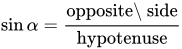
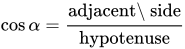
- if we consider a right-angled triangle O'P'H' similar to the triangle OPH, we can give (at least for acute angles) another geometric interpretation of the sine and cosine of an angle. From the proportions:
- ,

and

we immediately obtain
, (3)
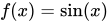
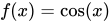
If we plot the functions and , we immediately see that they could be suitable for representing the amplitude of the oscillation of an oscillating body as a function of time, as soon as the abscissa x is replaced by the time t or some quantity proportional to it.
Think, for example, of the "pen" of a seismograph which, moving back and forth, records the local oscillations of an earthquake, or of the "pen" of an electrocardiograph which, oscillating, records our heartbeat: if this pen writes on a roll of paper unwinding at constant speed, simulating the passage of time, we obtain a graph of the amplitude of the oscillations as a function of time. Of course there is no reason why the oscillations obtained in this way should be sinusoidal (indeed, we would be amazed if they were!). But the "great book of nature" often surprises us: we will see that sinusoidal oscillations (which from now on we will call harmonic) are present in many concrete situations and indeed, as explained in the section Fourier's theorem, they are a sort of fundamental oscillation with which every kind of periodic oscillation can be described.
